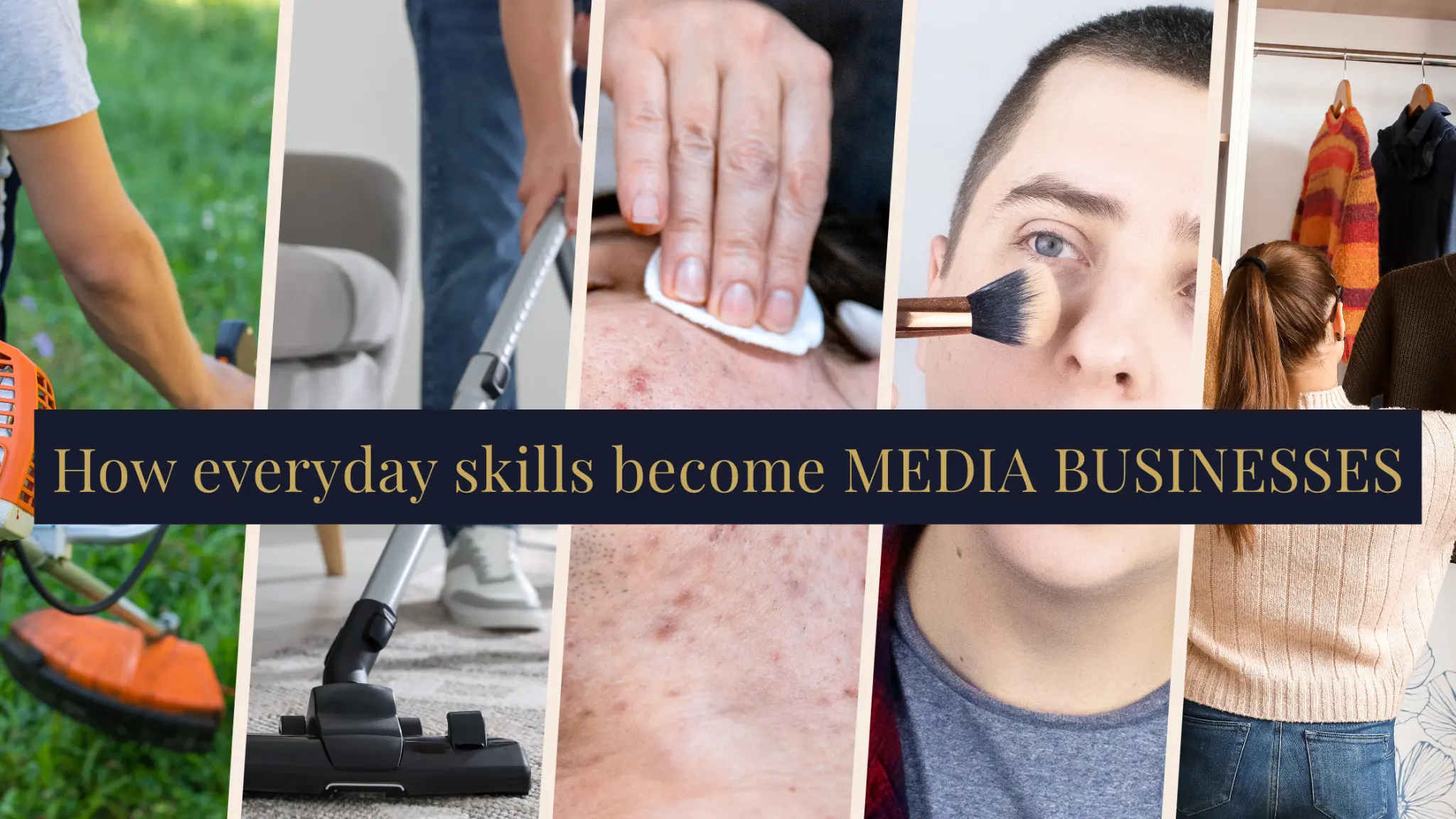
Have you ever been scrolling and found yourself emotionally invested in someone mowing a stranger’s lawn?
You weren’t looking for lawn care. You had things to do.
But now a sidewalk is slowly emerging from the weeds, and apparently you need to see this through.
Or you’re watching someone clean a kitchen that had become overwhelming for the person living there. As the space becomes usable again, you start imagining what that might mean for them.
Then comes the question:
That is a lot of work. For free? What’s the catch?
There’s a business model behind some of these transformations. Understanding it opens up a bigger conversation about work, media, and how useful skills can create value beyond the person directly receiving the service.
A lawn-care business becomes a media business
Spencer, the creator behind SB Mowing, knew how to cut grass long before he knew how to attract an online audience.
In his account of how the business developed, he describes starting with neighbors’ yards at eleven and eventually experimenting with filming free transformations. Those early videos involved evenings of physical work followed by hours of editing.
A reminder that “overnight success” usually has a decade and several blistered hands hiding behind it.
He later pursued advertising revenue and sponsorships to sustain the work.
That shift is the interesting part.
A conventional lawn-care customer pays for a maintained property. An audience watches the process. Advertisers and sponsors may pay to reach that audience.
The same work can serve a homeowner and create a media product.
The homeowner’s need and the viewer’s interest overlap, but they aren’t identical. Someone may watch because they need help themselves. Someone else may simply find the transformation satisfying.
No judgment. We all have our version of oddly satisfying content.
What feels ordinary inside one profession can be fascinating from outside it.
Auri Kananen turns cleaning into something people choose to watch
Finnish creator Auri Kananen, known online as Aurikatariina, films free home cleanings.
In an interview with Net Influencer, she described bringing years of professional cleaning experience into content creation, with paid sponsors eventually supporting her work.
There’s expertise inside the transformation: knowing what to tackle first, how to approach a surface, and how to make an overwhelming space manageable.
Viewers can follow the progress without knowing the trade.
You may already possess knowledge that other people would enjoy watching you use.
The challenge is finding the part that becomes a clear, engaging story.
But how much money are we talking about?
It’s a reasonable question. Especially if you’re reading this thinking, “Could something like this help me support my family?”
People considering a new business avenue need more than “follow your passion.” They need to understand what might pay the bills.
Public analytics services offer estimates, but they do not have access to a creator’s complete accounts.
When checked for this article on October 22, 2026, vidIQ’s public SB Mowing page estimated approximately $43,000 in monthly YouTube advertising earnings. It also reported approximately 6.86 million views over the preceding 28 days.
That is vidIQ’s modeled estimate, not earnings disclosed or verified by SB Mowing. It isn’t a profit figure, and it doesn’t establish income from sponsorships, other platforms, or other channels.
The estimate illustrates the potential scale of an established media operation. It shouldn’t be treated as a promise of earnings.
There is no reliable “average creator income” established by these examples. These are successful businesses, not a representative sample of everyone who starts filming.
For someone evaluating their own idea, the more useful next step is to understand the mechanics.
What the arithmetic could look like
Let’s do some actual math, because “it depends” has never paid a single bill.
The following are hypothetical scenarios, not industry averages or estimates of these creators’ earnings.
For advertising, RPM means revenue received by the creator per thousand views.
| Illustrative scenario | Calculation | Revenue before expenses and taxes |
|---|---|---|
| 100,000 monthly views at an assumed $3 RPM | 100 × $3 | $300 |
| 500,000 monthly views at an assumed $5 RPM | 500 × $5 | $2,500 |
| One negotiated sponsorship paying $2,000 | Agreed campaign fee | $2,000 |
| The second scenario plus that sponsorship | $2,500 + $2,000 | $4,500 |
Actual RPM and sponsorship fees vary. Short-form and long-form videos can have very different economics. YouTube also requires eligibility and review before creators can access relevant monetization features.
YouTube’s partner earnings overview explains its revenue-sharing arrangements. Those arrangements determine how qualifying revenue is divided; they don’t guarantee a particular payment per view.
And $4,500 in revenue isn’t $4,500 to take home. Labor, equipment, supplies, transport, editing, insurance, and administration still need paying.
The business becomes interesting when you understand both what can come in and what it takes to deliver.
Sponsors can support more than the video
There is documented sponsorship behind these businesses.
KCUR’s reporting on SB Mowing described equipment supplied by sponsors including Hustler and Maruyama.
Auri’s Net Influencer interview describes sponsorship support from Scrub Daddy, including help enabling a cleaning trip abroad.
The commercial fit is understandable: audiences see products used in a relevant setting, doing actual work.
Support may take several forms:
- A cash payment for an agreed integration.
- Equipment or supplies that reduce operating expenses.
- Travel or project costs covered by a partner.
- Other negotiated arrangements.
The cited examples establish that support exists. They don’t disclose what each contract pays.
A good partnership can help make the next project possible. Its value deserves to be measured in both revenue and costs avoided.
An audience can also become a community resource
SB Mowing’s work with a homeowner named Beth shows another kind of value.
After sharing her lawn transformation, Spencer organized a fundraiser for accessibility improvements and support around her home.
When checked on October 22, 2026, the public “Help Beth Gain Accessibility and Comfort” GoFundMe displayed $965,700 raised, with roughly 38,000 donations.
Those are funds raised for Beth’s support, not SB Mowing’s advertising income or business profit. The displayed total also isn’t, by itself, an accounting of completed work or disbursements.
What began as help with one lawn became an opportunity for thousands of people to contribute toward a larger need.
That’s where the story becomes bigger than the creator’s earnings.
A creator’s relationship with an audience can help connect people who need support with people willing to provide it.
That’s a form of social currency with consequences beyond a screen.
Dr. Pimple Popper shows how far the idea can travel
Dermatologist Dr. Sandra Lee offers a related example, although her business is different from the free-service model.
Her professional work became the basis of a media brand, television programming, and a skincare company.
In a 2023 interview with Beauty Independent, Lee said she reinvested YouTube earnings into her media business and the development of SLMD Skincare. She reported an initial skincare launch investment of $300,000–$500,000.
That figure belongs to a particular stage of her business. It isn’t a starting budget everyone needs.
The larger lesson is that media can generate resources, audience knowledge, and opportunities that support something else.
And apparently, a procedure some of us would watch through our fingers can be someone else’s favorite viewing.
Your daily work may contain a story you’ve stopped noticing.
A smaller production can still involve serious work
These examples expand what a media business can look like.
Some formats can begin with a small recording setup. Their strength comes from a visible process, useful expertise, and a reason to keep watching.
But modest production doesn’t mean minimal effort.
There are projects to arrange, permissions to discuss, equipment to maintain, footage to capture, and hours of editing afterward. The service itself still requires skill and care.
For anyone exploring this model, I would start with a small pilot and track:
- The hours required for the service and the media.
- The full cost of each project.
- What viewers actually watch and respond to.
- Whether the process can be repeated without exhausting the people doing it.
Treat early income as something to establish through evidence. A video going viral is a possibility; it’s a difficult operating plan.
How do you let viewers witness help while protecting dignity?
This question matters as much as the revenue. Maybe more.
A neglected space tells us that work needs doing. It doesn’t tell us the whole story of the person living there.
We shouldn’t diagnose someone from their home or assume a dramatic transformation requires a painful personal confession.
On her website, Auri describes anonymous cleanings, hiding or blurring identifying paperwork, and using filming agreements. These are her stated practices, rather than an independent assessment of every video.
They offer concrete measures to consider. They also leave room for further questions:
- Does someone understand how the footage will be used and monetized?
- What choices do they have about identification and personal details?
- Can a title invite curiosity without humiliation?
- What happens if they welcome help but feel uncomfortable being filmed?
Gratitude shouldn’t have to be performed for the camera.
The recipient remains a person with preferences, boundaries, and a life that continues after the upload.
Is this one possibility for the future of work?
I think it deserves a place in that conversation.
These businesses connect skills, storytelling, distribution, and outside funding in ways that can make useful work financially sustainable.
They don’t offer a universal answer to unemployment or financial insecurity. Audience-building is uncertain, and platforms can change the conditions under which creators earn.
But they do invite a different question about work we already know how to do:
Could this skill serve someone directly—and become something others value watching, learning from, or supporting?
For a person or organization exploring new possibilities, that’s worth investigating.
A clear audience matters. So does a repeatable format. And the person behind the camera needs enough judgment to recognize when a story should remain private.
The opportunity is to build a model in which useful work can continue, the creator can earn a livelihood, and the person receiving help retains their dignity.
Sometimes the result is a growing business.
Sometimes it’s an audience discovering a way to contribute.
And sometimes it’s someone opening their front door to a path they can finally use again.